The February sun comes through my home office window at a low angle this time of year and lays a pale stripe across the floorboards beside my desk. The tea in my cup has gone half-cold while I've been watching it. There is nothing remarkable about this — it happens every morning the sun shows up. But I have noticed that on the mornings the stripe is there, I write better. The day starts inside me a little differently.
I used to think of my house as the place I lived. After forty years of sitting with families in their homes — kitchens, sickrooms, back porches, hallways crowded with walkers — I think of it as something else now. The house is a participant. It is doing work for me, or working against me, depending on how I've arranged it.
What your home is doing for you (whether you've noticed or not)
Researchers who study aging at home have known for a long time that the physical environment matters more than most of us give it credit for. The National Institute on Aging's guidance on aging in place makes a quiet but firm case: light levels, clutter, room temperature, and the layout of the spaces we move through every day shape mood, sleep, cognition, and safety. AARP's 2024 Home and Community Preferences Survey found that 81 percent of adults over 50 want to stay in their homes as long as they can — up from 77 percent in the same survey's 2021 edition. What that survey doesn't say out loud is that staying is not the same as thriving. A house can hold you and quietly drain you at the same time.
This isn't about decorating. It isn't even, exactly, about the basics of aging in place — the grab bars and the threshold ramps, important as those are. It is about the rooms doing their work. The light coming in. The chair that fits the body you have now, not the one you had at fifty. The smell of coffee in the morning. The view from the kitchen window. These are not soft topics. They are structural supports.
Light: the thing most people get wrong
Older eyes need more light than younger ones — not softer, more. The shift is gradual from about age 40 onward, but by the time we are in our seventies, the lens of the eye is letting through roughly a third of the light it did at twenty. The instinct in late middle age is often to dim things, to soften the corners, to make rooms cozier. What I have found in my own home and in the homes I visit is that the cozier we make them, the harder they become to actually live in. Reading slows. Stairways turn into hazards. Mood follows the dimness down.
The fix is rarely expensive. Pull the curtains all the way open in the morning, not halfway. Move the favorite chair toward the window, not away from it. Swap the warm yellow bulb over the reading spot for a daylight-spectrum one — they are sold at any hardware store now for a few dollars. Researchers studying circadian rhythm have shown that bright light early in the day helps the body's internal clock stay regulated, which means better sleep at night and steadier mood through the afternoon.
My desk faces the window for a reason. I figured this out slowly, after years of writing at a table on the other wall.
The rooms you live in, and the ones you avoid
After Harold died, I did not eat at the dining room table for almost two years. I did not decide this. I just stopped, and then one day I noticed I had stopped. The table was there. The chairs were there. The room sat behind me every evening, dark, waiting. I ate standing at the counter or on the couch, and the dining room turned into a kind of museum of a meal we used to have.
This is a thing I see all the time. After a spouse dies, after the children move away, after retirement closes a chapter, certain rooms get abandoned. The room is too quiet, too associated, too much. It is not the room's fault. It is that the room is still arranged around a life that has changed shape.
I am not suggesting anyone redecorate their grief away. But I have come to believe there is a difference between honoring a room and avoiding it. What I did, eventually, was move my reading chair into the dining room — facing the window that looked into the side garden — and start eating breakfast at that table again, alone, with a book. The room came back. It is not the room it was. It is a room that fits the life I have now, which is the only honest way to live in a house.
If there is a room in your home you have stopped using, it is worth asking why. Not to push past the answer, but to know it. Sometimes the answer is that the room never suited you in the first place, and now you have permission to change it.
What ritual objects do
My mother kept a small ceramic bowl on her kitchen windowsill — pale blue, with a hairline crack down one side. She put her wedding ring in it every night when she did the dishes and put it back on in the morning. Toward the end, when her Alzheimer's had taken most of the words and a good part of who she had been, she still put the ring in the bowl every night. The bowl was telling her who she was.
Researchers in environmental gerontology talk about ritual objects as anchors. A favorite mug. A chair by the window. A photograph in a specific frame. These things are not sentimental clutter, though we are often told they are when we are encouraged to downsize. They are the physical reference points by which we know ourselves across the changes. Memory shifts. Bodies change. The objects that have moved with us through the seasons hold the thread.
In my Tuesday circle at Seasons of Grace, the program I have run in Asheville at the foot of the Blue Ridge for twenty-five years, I have watched people carry specific objects through the hardest passages of their lives. A woman who lost her husband to lung cancer kept his reading glasses on her nightstand for a decade. A man widowed at seventy-eight wore his wife's wedding band on a chain around his neck. These were not refusals to move forward. They were how those people kept their footing while everything else moved underneath them.
Look around your home. The cup you reach for in the morning. The chair you sit in to make a phone call. The picture you have moved three times to keep it in the light. Those objects are doing work. Pay them the respect of knowing what they are.
The kitchen as anchor
The kitchen is the room in my house that runs on routine, and I have come to think of routine as a structural support for mood — not a small thing, not a personality trait, but a real piece of architecture you build into the day.
I grind coffee at the same time every morning. Bread on Saturdays — flour on the counter, the radio on low, my hands in the dough. These are not performances of domesticity. They are nervous-system regulation. The smell of coffee, the rhythm of kneading, the sound of water boiling — these sensory cues tell the body it is in a familiar place. For anyone whose days have lost their old shape — retirement, widowhood, the children grown — the kitchen can be the room that holds the day together.
A few small changes make the kitchen kinder to the body you have now. A stool tucked under the counter so you can sit while you chop. A kettle close to the mug so you are not crossing the room with hot water. A small lamp on the counter for the times when the overhead light is too much. If funding any of these changes is the barrier, there are programs that help cover the cost — area agencies on aging, USDA rural housing grants, weatherization assistance. The kitchen does not have to be a project. It has to be a place you want to be at 7 AM and at 7 PM.
Porches, windows, and the world outside
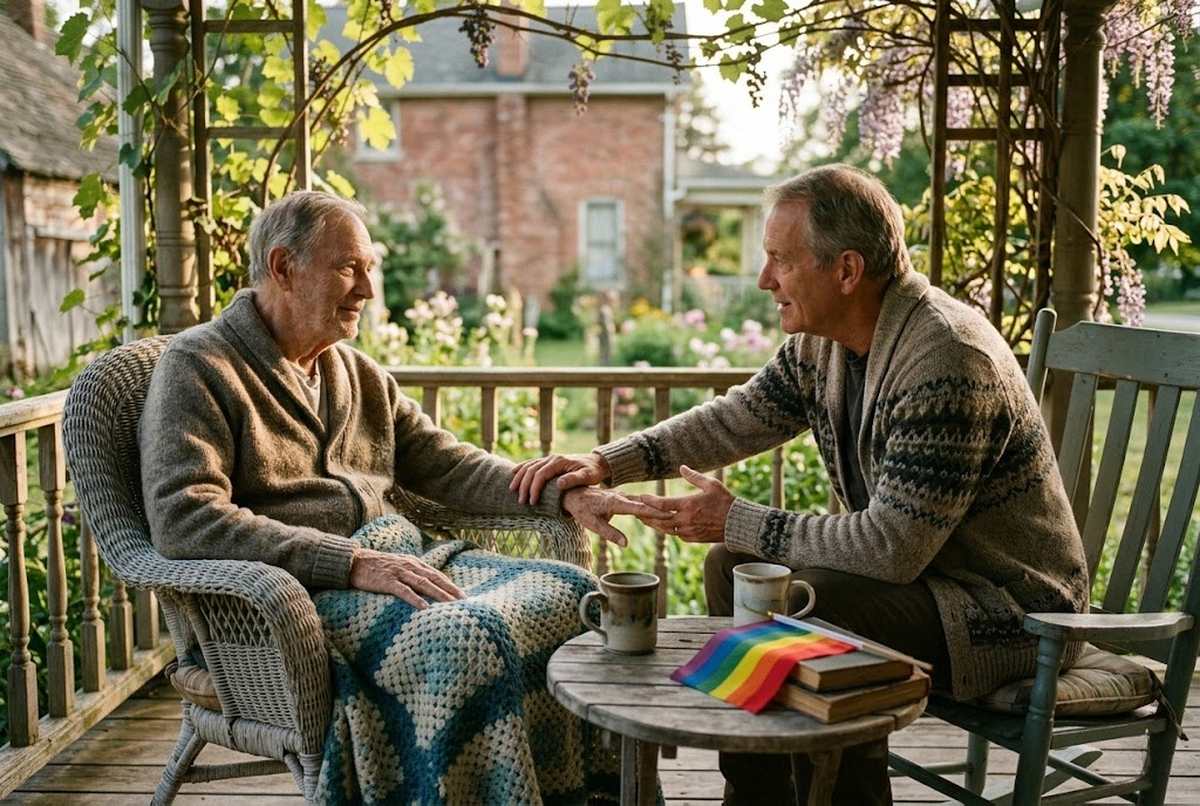
My front porch has rhododendrons on either side of the steps and a wooden rocking chair I have had since 1998. In the evening I sit out there before going inside for the night — sometimes for ten minutes, sometimes for an hour. A neighbor walks his dog past at the same time most evenings. We wave. The porch is where the day ends, where I let go of what I have been carrying.
The medical literature on what nature exposure does for older adults is solid and not particularly surprising. Roger Ulrich's landmark 1984 study found that hospital patients with a view of trees through their window recovered faster and asked for less pain medication than patients facing a brick wall. Studies since have piled up around that finding — natural views, even brief ones, even through glass, lower stress markers and improve mood.
Not everyone has a porch or a yard. What I tell people is that the principle scales down. A chair positioned to see out a window. A bird feeder hung where it is visible from the place you sit most. A window box with herbs. A potted geranium on a fire escape. The point is contact with the world outside the four walls — the changing light, the weather, something alive that is not you. Open the blinds. Open the window when the weather lets you. Adequate lighting along the porch steps and entryway matters for falls prevention too, especially in the dim hours when most stumbles happen.
Making peace with how you live now
Isn't it interesting how a home can stay arranged for years around a life that ended? The desk that was for the work you no longer do. The guest room set up for the grandchild who is now twenty-three. The recliner positioned for two when there is one of you. None of this is sad. It is just true, and it is worth noticing.
What I have found is that the most useful question to sit with is this one: does this room still match the person I am now? Not the person I was at fifty, not the person I imagined I would be in retirement, but the actual person sitting in this chair at this hour. If the answer is yes, beautiful. If the answer is not quite, that is information.
Some people I have known reorganize their lives after retirement quietly, one room at a time, over a year or two. Others wait for a moment of clarity that arrives unbidden — a morning when the light hits the floor a certain way and they suddenly know what the room should hold. There is no schedule for this. There is only the noticing, and then the small acts that follow.
This week, if you want a place to begin: pick one chair, in one room, and move it so it faces a window. Sit in it tomorrow morning with whatever you usually drink. See what the room does. The Blue Ridge is doing its slow spring thing outside my own window as I write this — the dogwoods coming in, the light getting longer. The house is participating. That is what a home does, when you let it.