Donna called
Donna Wieczorek called me on a Wednesday in March. We taught at New Trier together — she had AP History in the room next to my English class for twelve years, and we shared a wall and a microwave and a low opinion of faculty meetings. She retired two years before I did. She moved to Madison to be near her daughter. Her husband Alan died in October. By March, she'd had eight months of the kind of grief nobody quite tells you about and a calendar with nothing on it.
She cried for about ninety seconds before she got the question out. I let her. That's what the call was for.
Then she said: "Victoria, how does a person make a friend at 71?"
I taught high school English for thirty-four years. I have an answer for almost everything. I once explained iambic pentameter to a sophomore class during a fire drill and finished the soliloquy in the parking lot. I did not have an answer for Donna's question.
I told her I'd call her back.
This is what I called her back with — most of it figured out the hard way over the year since that Wednesday. Partly for Donna. Partly because two of my own oldest friends have died in the last three years and the women who'd been my safety net for forty years are starting, with no warning, to disappear. Partly because Frank, who I love, is one person, and one person isn't enough.
The thing the Surgeon General called an epidemic
In 2023, U.S. Surgeon General Vivek Murthy issued a federal advisory titled Our Epidemic of Loneliness and Isolation. The findings: chronic loneliness raises dementia risk in older adults by roughly 50 percent. Lacking social connection has the health impact of smoking fifteen cigarettes a day. Social isolation costs Medicare around $6.7 billion a year in excess spending. It's still the active federal frame — HHS reaffirmed it under the National Strategy to Advance Social Connection.
Dr. Murthy speaks doctor and that is fine. What he called an epidemic in 2023 is what 71-year-old widows have been calling Tuesday for several thousand years. We are the data. The question isn't whether we're lonely. The question is what we do about it. (If you're reading this from the inside of a house you live in alone, you already know that part.)
Friendship after 60 is a skill, not a feeling
Here's the thing nobody says out loud: at 25 you made friends by accident. The apartment building. The first job. The kids' soccer team. The accidents kept happening for forty years and you mistook the accident-machinery for a personality trait — I'm good at making friends.
At 70, the accidents stop. The job is gone. The kids are grown. The apartment building is your house, where nobody new moves in. If you want a friend now, you have to engineer the accident. That's the whole game.
Where people actually meet each other after 60
The listicles tell you to "find your tribe." Nobody knows what that sentence means. Here is what should have been written instead — actual places, with phone numbers, that work. (Some of this overlaps with the smaller daily moves I wrote about elsewhere — different question, related answer.)
Senior centers. Find yours through the Eldercare Locator: 1-800-677-1116 or eldercare.acl.gov. Free. They have lunch, walking groups, mahjong, current-events discussion, and almost certainly something you'd attend if you walked in. The honest part: the first three visits feel like the first day of seventh grade. Go anyway. By visit four you'll have a regular table. (More on what's actually happening at these places.)
OLLI — the Osher Lifelong Learning Institute. 125 university-based programs, one in every state. Membership runs $35 to $300 a year depending on the campus. No tests, no grades, no papers. You sit in a room with twenty other people who chose to be there and discuss literature or philosophy or current events for ten weeks. Search "OLLI" plus the name of the nearest university. If you live within driving distance of a college, you have one.
The public library. Book clubs, film discussions, knitting circles, computer help. Free. Happening in your zip code this week. Nobody under 50 knows about them. (Bring a book worth talking about so you have something to say in the second hour.)
Walking groups. Walk With a Doc is a free monthly walk led by a local doctor — no appointment, no cost, just show up. The American Volkssport Association organizes longer walks all over the country, three dollars to enter, all ages, friendly. Meetup.com still works for "[your town] senior walking group."
Religious communities, even if you're lapsed. Episcopal coffee hour, Catholic parish potluck, the Reform synagogue Sisterhood, the Quaker meeting house. The social infrastructure exists already and they will not interrogate your theology. Donna is culturally Lutheran and started showing up Sundays at the Episcopal church on State Street because, as she put it, "Episcopalians are slightly off but the coffee is better."
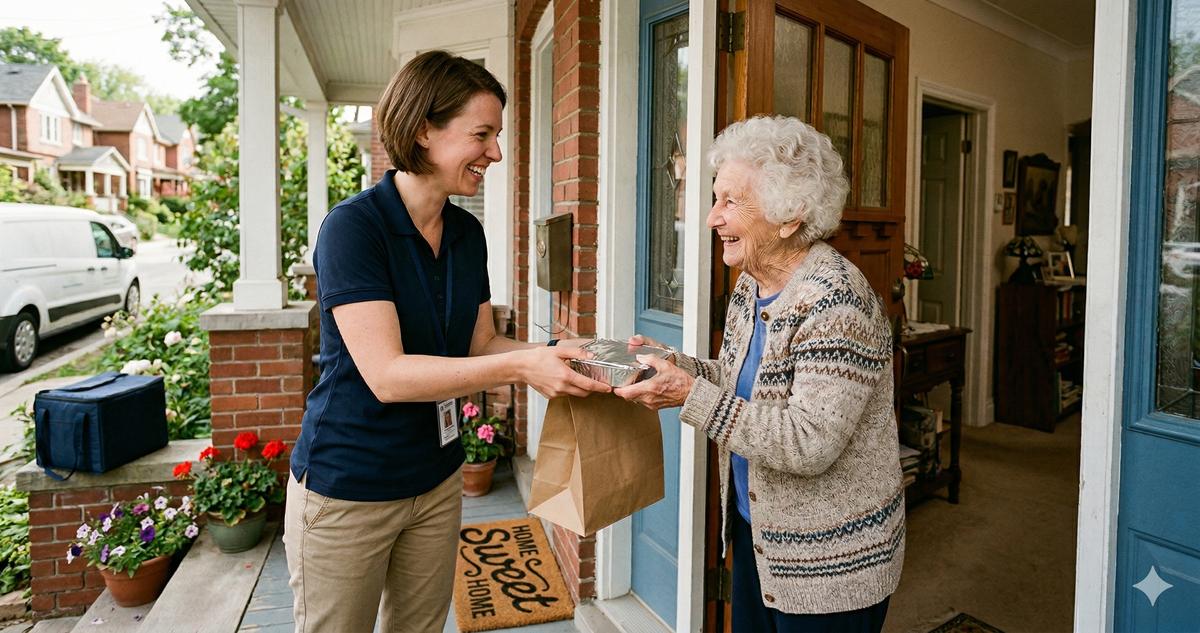
Volunteering with an actual schedule. This is the move. Not a one-off charity event — a route. Meals on Wheels routes pair you with a partner and the same houses every week, and friendships happen in cars between stops. The federal Foster Grandparent Program through AmeriCorps Seniors places you in a school or Head Start program and pays a small stipend. AARP Experience Corps puts you in a classroom doing literacy tutoring. The trick is the schedule. Same time, same place, same people, every week. Schedule equals repetition equals friendship.
Pickleball. Yes. Yes, it's a cliché. It still works. The barrier is comically low and you'll be playing in thirty minutes. Look for it at the senior center, the YMCA, or on a converted tennis court in a park near you. Your knees will tell you whether to keep going.
What NOT to do
Nobody writes this part. They should.
- Don't expect one event to do it. Friendship is repetition. Six times minimum before anything sticks.
- Don't try to recreate the friendships you had at 35. Those took twenty years. The new ones will not be those.
- Don't make the church or temple or center about theology. Make it about coffee hour.
- Don't talk about your health for the first three meetings. Frank's knee replacement is not an opener.
- Don't, for the love of God, lead with my husband died. Lead with the chair you sat in. Lead with the weather. The grief comes out when it's ready, and the friend will be there to catch it.
Scripts for the awkward moments
The listicles never give you these. Real lines for real situations.
First time at the senior center, you don't know anyone. "Mind if I sit here?" That's the whole script. Sit. Don't speak for two minutes. Listen. Eventually someone will ask if you're new. Say: "First time. I retired four years ago and I'm starting to talk to my plants." The plants line gets a laugh every time and breaks the door open.
Someone asks what you used to do. Don't give the resume. Give one specific moment. "I taught high school English for thirty-four years and once I read 'To be or not to be' through a fire drill." That's a person, not a job title. The person across from you will give you a moment back.
You ran out of things to say. Skip "How are you" — it gets "fine." Skip "What's new" — it gets nothing. Try: "What's something good that happened this week?" Real answers come out of that question. Stories come out. Try it on Frank tonight.
You want to escalate from acquaintance to friend. This is the move nobody teaches. After the third or fourth time you've seen them, say: "I'm going to the farmer's market Saturday. Want to come?" Specific invitation, specific time. They'll come or they won't. Either way, you've moved the line.
They cancel and don't reschedule. Wait one week. Try once more. If they cancel a second time, move on without taking it personally. At our age, people are managing illnesses, grandchildren, and afternoons that feel longer than they used to. Some of them aren't ready to be a friend right now. That is information. Use it.
The five things people get wrong
- Treating loneliness like a personality flaw. It isn't. It's a public-health crisis the federal government issued an advisory about. You have not failed at adulthood. The social architecture of late life is missing in this country and you are being asked to build it yourself. That isn't fair. Build it anyway.
- Mistaking acquaintances for friends. The woman from the YMCA isn't your friend yet. She's an acquaintance. The friend comes after the third invitation. Most "I have no friends" statements at 70 are actually "I have eight acquaintances and I haven't asked any of them to coffee."
- Trying to make friends online when you mean in person. Facebook groups are fine for hobbies. They are not friends. Don't substitute the algorithm for a person.
- Refusing to be the inviter. Someone has to ask. At 70, that someone is more often you than them. You will get told no. The cost of the no is twelve seconds of awkwardness. The cost of never asking is the rest of your life. (I've written more on how to start when you live alone.)
- Telling yourself you're "introverted" as an excuse. Introversion is real. It is not an exemption from connection. You may need fewer people than your extrovert sister-in-law, but you still need some people. Three names on your phone. That's the bar.
The 4 a.m. thing — solitude vs loneliness
I sit in my kitchen at 4 a.m. some mornings with a cup of tea and no phone and no scroll, and I am alone, and I am fine. That isn't loneliness. That's solitude, and solitude is medicinal.
The distinction matters. Lonely is I want someone here. Solitude is I am here, with myself, on purpose. Some of the people who tell me they're lonely are actually under-soloed — they have never sat with themselves long enough to find out who's in there. Some of the people who tell me they're fine are actually crushed and well-disguised. Be honest about which one you are. The strategies are different. Donna was the second one.
Six months later, Donna
Donna joined OLLI at UW-Madison and signed up for the literature-and-philosophy track. She joined a monthly bread-baking class at Madison Sourdough on a whim and turned out to be the best baker in the room, which she did not see coming. She started showing up Sundays at the Episcopal church on State Street. She didn't love every week. She went back anyway.
Six months in, she had three names on her phone she'd text without overthinking it.
That's the bar. Not a circle. Not a movement. Three names you'd text on a Tuesday. Get to three. The rest takes care of itself.
A last honest thing
I wrote this for Donna and I wrote it for myself.
Frank is wonderful. Frank is not enough. Husbands don't count as friends, sweetheart. I know what you're going to say. Sit down. They don't. They are something else, something good, but they are not the friend you call on a Tuesday afternoon when you got bad news at the doctor and you don't want to scare them with it yet. That call goes to the friend.
If you don't have the friend, you make one. It is harder at 71. It is awkward. The HOA pool will not save you — last summer a woman named Gayle informed me my plastic tumbler of "lemonade" created a perception issue, and Gayle and I are not going to be friends, and that is fine. You make the friend somewhere else, on purpose, by going back to the same room six Tuesdays in a row until someone there knows your name and what you take in your coffee.
Three names. Start there. Donna got there. So can you.